
Veterinary compounding
Veterinary formulas calculated by weight, with the label and registers MAPA requires.
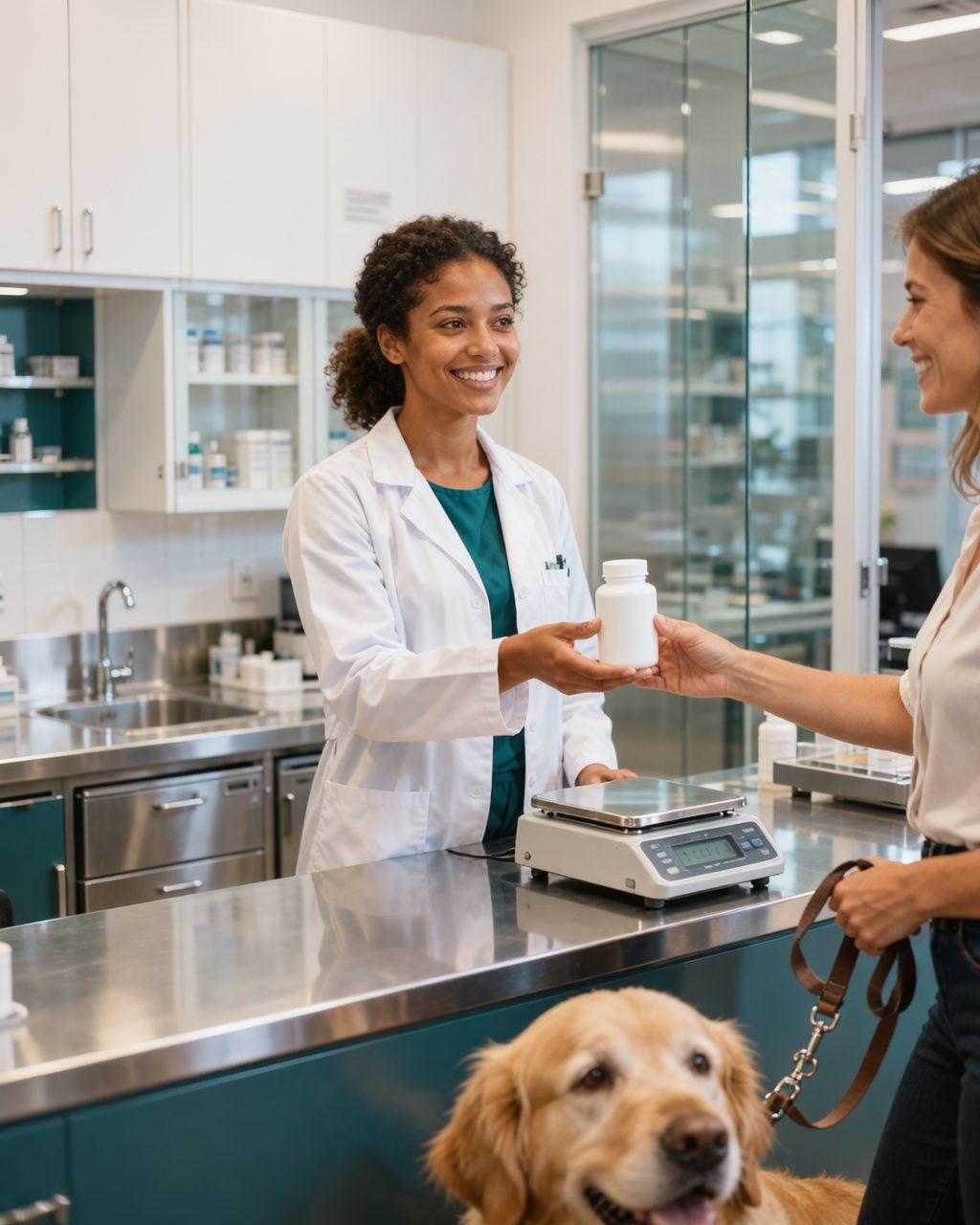
The veterinarian’s prescription comes in with the animal, its species, its weight and the owner. Marcos, an AI agent, calculates the formula from the dose and the weight and prepares the veterinary-use label; Lívia records controlled substances the way MAPA requires. The pharmacist assesses the prescription and approves the order.

Illustrative values.
The module agents
Marcos calculates and Lívia records. The pharmacist approves.
Marcos Tavares calculates each component from the prescribed dose and the animal’s weight, with the lot’s factors, and prepares the order and the veterinary-use label. Lívia Campos records veterinary controlled substances and prepares the registers and the semiannual report for MAPA. Assessing the prescription and approving the order are up to the pharmacist.

Marcos calculates the dose from the weight stated on the prescription, with the product and lot factors
Marcos prepares the compounding order and the veterinary-use label, with the animal’s and the owner’s details
Lívia records the inflows and outflows of veterinary controlled substances, with the invoice, the lot and the prescription
Lívia prepares the registers and the semiannual MAPA report for the pharmacist to check
Calculate Thor’s formula and prepare the order.
I calculated from the weight on the prescription: 1 mg/kg for 32 kg gives 32 mg of omeprazole per capsule. With the lot’s pellets at 8.5%, that is 376.5 mg per capsule, or 11.295 g for the 30 capsules. The label shows “Veterinary use” prominently, along with Thor, the owner and the formula’s number in the prescription book. Order 0412 is awaiting your approval.
Illustrative example.
Veterinary prescription
The patient is the animal, linked to its owner.
Each animal has its own record, linked to the owner’s, with species, breed and weight. Iris transcribes the prescription from the photo or PDF and registers the order. Without the veterinarian’s name and CRMV number, the order does not move forward.
Veterinarian with their CRMV number and address
Animal with name, species, breed and weight
Owner with name and address; reminders only for those who agreed to be contacted, with the consent on record
Substance by its DCB name, concentration, dosage form, quantity and dosage instructions
Formulas written in code or by brand name are rejected
Illustrative example.
Calculation and label
Dose by weight, and the label the regulations require.
Dose by weight
When the prescription gives the dose per kilogram, Marcos calculates the quantity per unit using the weight stated on the prescription. Without the weight, the calculation is rejected.
Lot factors
The quantity to weigh uses the lot’s dilution, correction factor and density, just as in human compounding. Without the factor, the calculation is rejected.
Range by species
The pharmacist enters the minimum and maximum dose of each substance for each species. Outside that range, the alert goes to the pharmacist, who asks the veterinarian to confirm.
Food-producing animals
For cattle, pigs, poultry and other species raised for human consumption, MAPA rules allow only homeopathic preparations. Other formulas are rejected.
Veterinary-use label
“Veterinary use” displayed prominently, plus the animal, the owner, the veterinarian, the formula’s number in the prescription book, the dates, the components, the dosage instructions and the responsible pharmacist with their CRF number.
No therapeutic claims
Decreto 5.053/2004 prohibits stating a therapeutic action on the label of a veterinary formula. For controlled substances, the label carries the band and the wording required by MAPA rules.
MAPA and controlled substances
Licensing and veterinary controlled substances, the way MAPA requires.
The module is turned on only at the branch that holds a MAPA license. Controlled substances follow Portaria MAPA nº 837/2025.
01
Prescription in triplicate
For controlled substances, a MAPA-registered veterinarian prescribes on numbered triplicate forms, valid for 30 days, or 180 days when marked for continuous use. The pharmacy keeps its copy, and Lívia links it to the outflow and the lot.
Lívia · records
02
Registers by list group
Lívia records every inflow, outflow and loss with the invoice, the lot and the prescription, within the seven-day deadline the rules set. The registers come out separately by group of lists (A, B1 and C), for substances and for products.
Lívia · prepares
03
Semiannual report
By July 31 and by January 31, the semiannual report goes to the state Superintendência de Agricultura (MAPA’s state office). The responsible pharmacist checks and submits it.
The decision is the pharmacist’s
What stays with people
The agents prepare. The pharmacist assesses, approves and is accountable.
01
Assessing the prescription
The pharmacist assesses the prescription and checks the dose calculated for the weight. Outside the range, the pharmacist asks the veterinarian to confirm: changing the dose is the prescriber’s decision.
02
Approve and release
The pharmacist approves the order and the label before they go to the bench and releases the formula after weighing. The release is recorded under the pharmacist’s name.
03
Check and submit
The responsible pharmacist checks the registers and submits the semiannual report to MAPA. When an entry is wrong, the pharmacist decides the correction, which goes in as a reversal without erasing the original.
Questions about veterinary compounding.
See a veterinary formula, from prescription to label.
In the demo, you see the prescription with the animal’s weight, the dose calculation, the veterinary-use label and the MAPA registers. We handle your pharmacy’s migration at no cost.